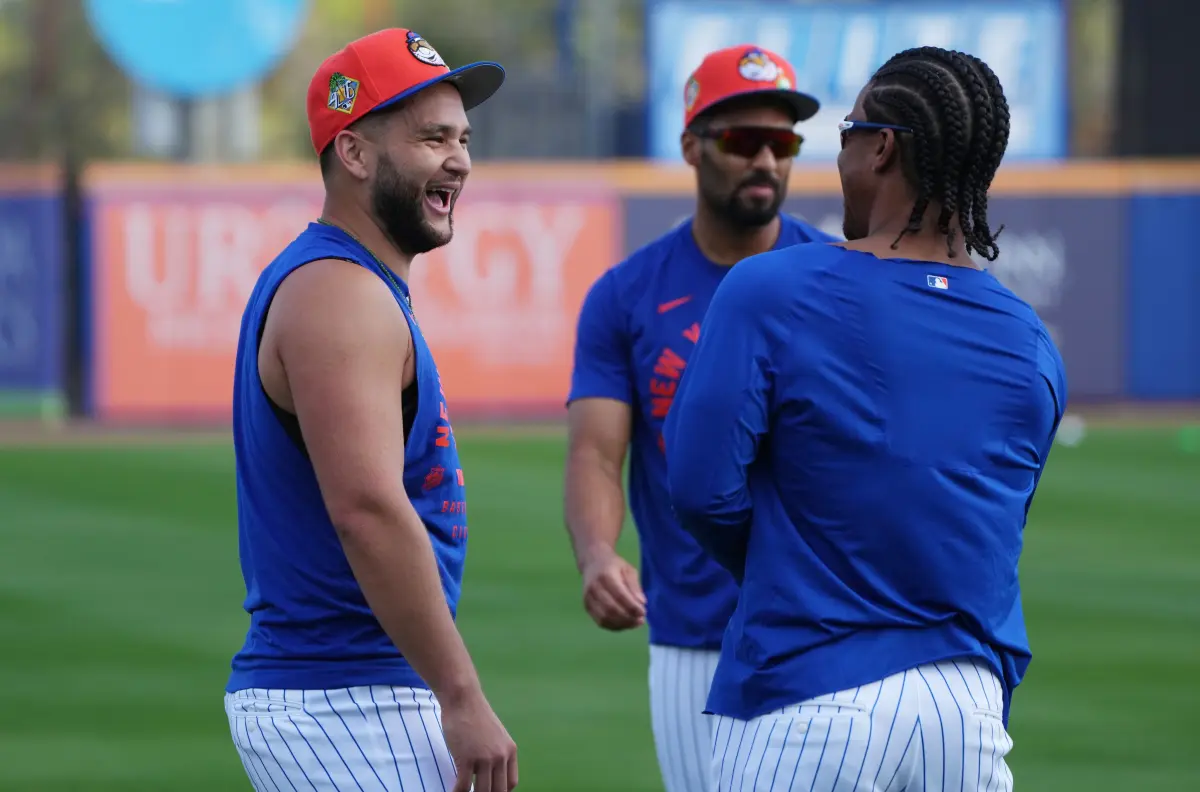
NL East: Adaptation, or You Are What You Love
Feb 23 2026
“You are what you love, not what loves you. That’s what I decided a long time ago.”
—Donald Kaufman, Adaptation (2002)
Despite having been born in New York City, growing up on Long Island, and being at a peak formative age when the team won their first World Series in 1969, there is no evidence writer Charlie Kaufman is or has ever been a Mets fan. Nevertheless, there may not exist a more Metsian quote in the history of cinema. This maxim should be framed and placed on home altars from Massapequa to Middle Village, as it perfectly captures the essence of what it truly means to be a fan of the Metropolitans. To follow this team is to enter into an implicit agreement: you will be disappointed, and your unrequited love must sustain you. But Kaufman’s words also highlight the underappreciated, self-affirming agency in that oft-one-way relationship. You can’t control your beloved’s behavior—hell, you may not even have a choice in what you love. But that love, after all, is your own. Instead of hating on a seemingly cursed attraction, you can choose to love that you love.
There are many things to recommend about Adaptation as a film, but the one we’d like to focus on here is its inventiveness. It’s a metastory about a writer (a fictionalization of the actual screenwriter, Charlie Kaufman) struggling to adapt a book into a screenplay. After resisting big budget movie tropes, the protagonist finds his inspiration in a series of unlikely, over-the-top third act developments that resolve both story and metastory. This triumph is only possible when he accepts that he must challenge his assumptions, start over, and embrace change. This was, in a nutshell, the story of David Stearns and this offseason’s adaptation of the Mets.
It's rare to see such deliberate wholesale change, doubly so on a big market team with a payroll to match and persistent expectations of contending. This wasn’t a teardown but a philosophical retooling, ostensibly about upgrading run prevention but more fundamentally about changing a narrative in media res. The story unfolding was about yet another Mets failure despite enormous investment and expectations. Stearns saw more of the same ahead due to current and potential contracts flopping down the road and decided not just to punch up but to rewrite. Gone are many of the longest-tenured and most beloved Mets characters. In their stead are an unorthodox mix of out-of-position infielders with a gift for putting the ball in play, a superstar decamping from right to left, a new ace, and just enough space for touted prospects to possibly emerge on a team otherwise crowded by pricey veterans. In a chaotic offseason third act, after months of teeth-gnashing and consternation, the 2026 Mets have come together.
Much of our attention over the next month will be on Bo Bichette and Jorge Polanco, given their new defensive assignments. What we most care about from a fantasy perspective is how this context will affect their value. Just the addition of eligibility at 3B (and CI, for Bichette) and 1B (and also CI, for Polanco) should make each player more attractive across the board and especially in formats like Best Ball, Draft Champions, and NL-Only. The big question, of course, is will they stick?
Stearns and his lieutenants are putting their faith in the fact that each player once manned the most challenging position on the field, and their new assignments are lower on the defensive spectrum. There are many examples of SS transitioning successfully to 3B (Ripken, A-Rod, Chipper Jones in the minors), and although fewer come to mind going to 1B, we can point to Ernie Banks and Nomar Garciaparra. But what if Bichette and Polanco can’t make it work or get injured trying?
Brett Baty would be the obvious choice to fill in at 3B if need be. The erstwhile incumbent got his manager’s vote of confidence as the starter at third during the Winter Meetings, only to be supplanted by Bichette’s signing. Instead, Baty is slated to basically take over the superutility role previously occupied by Jeff McNeil and should see time at 1B (currently learning), 2B, OF (he played some in MiLB), and at least a small handful (or more) at 3B.
While Ronny Mauricio is also an option at 3B—he played there extensively in winter ball—he’s currently in the running to cover for Francisco Lindor while the veteran heals from hamate surgery. Further down the line, Jacob Reimer, the Mets’ top 3B prospect, is in camp and expected to begin the season at AA-Binghamton, but could advance quickly to Triple-A if he continues last year’s trajectory (157 wRC+ between High- and Double-A). One player we probably won’t see in the 3B mix is Mark Vientos, who is transitioning to 1B/DH after several years of subpar defense at the hot corner.
As for 1B, manager Carlos Mendoza recently acknowledged that Polanco would see time there but would feature prominently at DH, referencing past health issues as a potential factor keeping him from an everyday role in the field. This could delay Polanco’s eventual qualification at 1B, which depending on the league might happen more towards the end of April than earlier. Both Baty and Vientos are also expected to get PT at 1B, with top first base prospect Ryan Clifford (137 wRC+ in AA/AAA in ’25) lurking only a stop away.
There’s more where this came from to help you win your fantasy league in 2026. Take the title home with a subscription to BaseballHQ.com.
Zack Wheeler underwent thoracic outlet surgery in September to address a blood clot in his right shoulder, leaving his 2026 ETA very much in doubt. While pronounced successful (and he reportedly kept the excised rib in a bag in his closet), the procedure led to an atypical offseason for the ace. He’s not expected to be ready for Opening Day, but he has been throwing in camp, most recently from 120 feet. The typical recovery time for TOS is 6-8 months, so a return as late as June can’t be ruled out, although Wheeler is of course hoping for something sooner.
To give a bit more context on TOS, there are two types: neurogenic (in which pressure on nerves is relieved) and vascular (pressure on blood vessels is relieved). The neurogenic type has seen fewer successful recoveries in baseball, with Matt Harvey and Stephen Strasburg two of the most high-profile casualties. Wheeler had vascular TOS, the “better” of the two surgeries in terms of baseball outcomes, which Merrill Kelly had in 2020 and has since been able to throw 793.1 IP with a 3.66 ERA—although he did post his MLB season-worst 4.44 ERA in 158 IP the year immediately following his surgery.
This all makes for an uncomfortable reckoning in fantasy: how to account for a consistent top-5 SP with serious injury risk for 2026. BHQ currently has him projected for 138 IP, 3.39 ERA and 1.10 WHIP, which presumes he could come back late May and builds in some injury regression to his rate stats. It’s hard to pin down what a true 50th percentile outcome should look like here, as many of the worse ones could involve fewer innings, worse production, no innings at all, or the worst possible outcome, more innings and worse production. Wheeler’s ADP has hovered around 151 in February 15-team NFC contests, or early 11th round, near Drew Rasmussen, Trey Yesavage, Nathan Eovaldi, Bubba Chandler, and Luis Castillo, which is smack dab in the province of SP 4 veteran injury risks and high-upside young hurlers. If you can wait until later in the spring, keep an eye on his progress. If not, watch for Wheeler to drop below 150th and consider whether your roster construction and league rules would allow for a sensible dice roll.
Brady House comes into camp as the presumptive third baseman. He took over 3B duties in June after asserting himself in Triple-A (127 wRC+) and found the going much more challenging at the MLB level: .234/.252/.322, 4 HR, 5 SB in 274 PA. Under the hood, things were rough as well: 2% BB%, 70% ct%, 82 xPX, 47% GB%. The silver linings, such as they are, were his 108 Spd (though only 83 RSpd due to 3 CS) and “B” exit velocity on his QBaB score. What can we expect from the 22-year-old in his sophomore campaign?
Here's where we’ll point out that the Nationals’ new manager, Blake Butera, could be a boon to a player like House trying to find his footing after struggling initially. You see, Butera, besides being young enough to be House’s older brother (he’s 33), is coming off a stint as senior director of player development for the Rays. Along with fellow new wunderkind President of Baseball Operations Paul Toboni (age 35), Butera could be an ideal choice to help shepherd the young Nationals through their growing pains.
It's hard to say if Butera's recent experience in player development would make him more or less likely to suggest sending House back to Triple-A for more seasoning if he were to get off to a slow start. One factor that could help House stave off a demotion is his plus defense at 3B (+2 OOA), but that would only delay the inevitable if he can’t improve substantially on last year’s .574 OPS. If you’re looking for green shoots, House did homer twice on Sunday, once off an 83.8 mph sweeper from Sandy Alcantara, and then again off an 81.2 mph changeup from Evan McKendry. Two bombs are definitely encouraging, but as spring unfolds look for signs that House is also making loud contact off fastballs, as he struggled mightily against velocity in 2025 (.286 xwOBA).
The plan headed into 2026 is to have 2025 NL ROY Drake Baldwin start the season in the pole position at C, with his eventual partner behind the plate Sean Murphy aiming to join the team sometime in May after undergoing surgery to repair a right hip labral tear that had been dogging him for years. According to Harrison Smajovits writing for Sports Illustrated, Braves manager Walt Weiss has this update on Murphy’s progress:
“Murph's right where he needs to be. He looks great. Walking around. He's progressing little by little. They're giving him a little more at a time. He's checking all the boxes along the way.”
These are encouraging words, but also very much in the vein of all vague and hopeful managerial spring training injury-speak. For reference, Buster Posey had a similar labrum repair in 2018 and successfully returned to play two more seasons before retiring.
Barring any true setbacks in camp, there won’t be much more for fantasy managers drafting over the next few weeks to go on besides Murphy’s recent injury history, which in addition to the nagging hip also has included a fractured rib in 2025 and strained left oblique in 2024 that cost him 59 days on the IL. Despite limited PT, last season he smashed 16 HR and collected 45 RBI in only 337 PA, a rather productive-looking season provided you hold your thumb over his .199 BA, which is low even for a low-end C1 or luxury C2. Murphy’s .229 xBA suggests he was pretty unlucky in that department, and we can assume the damaged hip might have contributed to the career-low 63% ct%. He’s currently the 27th C off the board in NFC drafting, and given the power he displayed in spite of the hip injury (123 xPX), Murphy makes for a perfectly reasonable later-round gamble especially in two-catcher leagues—as long as you can stash him without stressing your roster.
Agustín Ramírez was bad defensively behind the plate in 2025. How bad? Since Statcast began tracking Blocks Above Average in 2018, Ramírez’s -28 figure represents the worst single-season total in MLB. His -10 Catcher’s CS Above Average, tabulated since 2016, ranks as the 3rd worst seasonal result. Pretty much the only aspect of his catching that rated above average was his Framing (+1), but just barely. How long will Miami keep him behind the plate, who might replace him, and what would become of him if he were to finally shed the tools of ignorance?
Jordan McPherson, writing for The Miami Herald, confirmed the widely-acknowledged fact that Ramírez must improve to stay behind the plate. Manager Clayton McCullough had this to say: “He looks great physically, and I have a lot of confidence that Gus is going to be a much-improved defender as we get moving.” For the foreseeable future, at least as it relates to the 2026 season and very likely 2027, fantasy managers can expect to be able to fit Ramírez’s very useful bat (21 HR, 16 SB, .701 OPS in 585 PA) into an open C slot. We should note that, even last year, he split his time between C and DH almost evenly (71 G at C, 63 at DH).
From a fantasy manager’s perspective, if you draft Ramírez, you may be rooting for him to make as many starts as possible at DH. Why? His splits from last year suggest the stress of catching may have taken a toll on his offense: .627 OPS, 73 wRC+ as C; .786 OPS, 112 wRC+ as DH.
The Marlins are lucky to have a top C prospect in Joe Mack knocking on the door. He’s currently in camp after performing admirably in the minors in 2025 (21 HR, 9 SB, 120 wRC+ in 468 PA between AA/AAA) and is regarded as a top-tier defensive catcher who won a 2024 Minor League Gold Glove. They also have Liam Hicks, who was just about league average in 2025 with the bat (98 wRC+), displayed a robust 11% BB%, solid 83% ct%, .256 xBA, and surprising 120 RSpd, and is projected to split time at C, 1B, and DH. Hicks didn’t show much power potential (81 xPX, “D” EV on QBaB score), but if he can accumulate PA spread out over several positions, he could be a sneaky $1 play in deep 2 C leagues.
More From PT Tomorrow
A slugging Yohandy Morales tries to pound out a spot for himself on the 2026 Nationals and beyond. Plus: SS in ATL; bench in PHI; Marsee in MIA; Tong at NYM; more.
Sep 15 2026 10:05am
Sep 15 2026 10:05am

This week, we point out an under-the-radar option in L.A., welcome starting pitchers back to Arizona and San Diego, check in on a favorite of ours in Colorado, and take a closer look at the Giants' starting rotation.
Sep 12 2026 3:05am
Sep 12 2026 3:05am
A look at how free agency, potential call-ups, and other roster decisions might impact lineups, rotations, and bullpens for all five teams next year.
Sep 10 2026 3:05am
Sep 10 2026 3:05am
After a brief demotion, Mickey Gasper's playing time has new life and may be gaining staying power. Plus, Aaron Judge looming for NYY, and more late-season playing time fallout.
Sep 8 2026 3:05am
Sep 8 2026 3:05am
This week, we say "hello" to yet another San Diego catcher, welcome another catcher back to L.A., try to read the playing time tea leaves in Arizona and Colorado, and check in on two Giants' rookies who are playing at a high level.
Sep 5 2026 3:06am
Sep 5 2026 3:06am