
J. Naylor, Bradish, Robert, Bubic, Mullins
Jan 19 2026
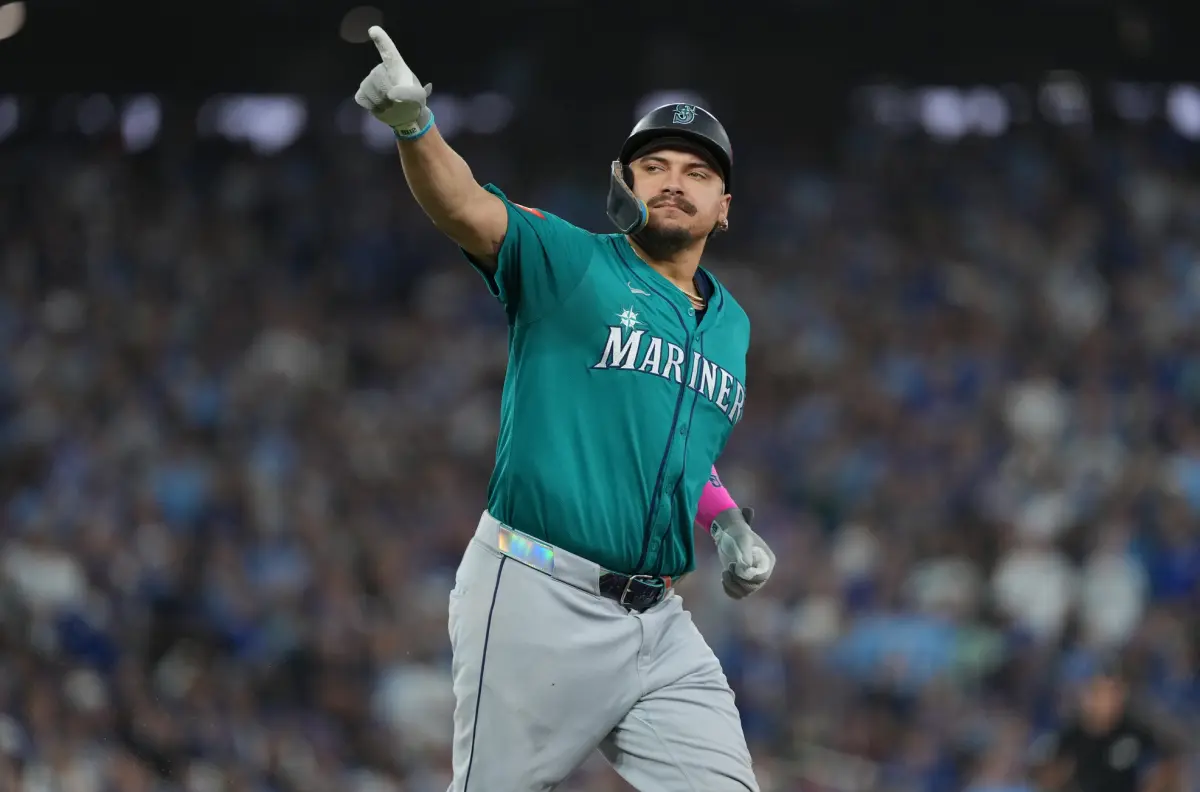
Naylor ran wild in 2025... Josh Naylor hit 20 home runs and stole 30 bases, with a .294 batting average across 604 plate appearances. For context, Naylor stole 22 bases over the previous three seasons, with 25 in his career before 2025. Naylor agreed to a five-year contract with the Mariners during the off-season. Can he continue his success into 2026?
| Season | PA | HR/SB | BA/xBA | ct% | h% | QBaB | GB%/FB% | PX/xPX | HR/F | SB%/SBO | BPX |
| 2021 | 249 | 7/1 | .253/.254 | 81% | 29% | BDf | 49%/32% | 85/85 | 12% | 100%/2% | 115 |
| 2022 | 498 | 20/6 | .256/.278 | 82% | 27% | BCf | 49%/34% | 119/89 | 16% | 86%/7% | 221 |
| 2023 | 499 | 17/10 | .307/.282 | 85% | 33% | CCd | 42%/37% | 101/96 | 12% | 77%/10% | 211 |
| 2024 | 632 | 31/6 | .243/.277 | 81% | 25% | BCf | 47%/36% | 121/93 | 19% | 75%/6% | 232 |
| 2025 | 604 | 20/30 | .294/.272 | 85% | 32% | CCc | 46%/37% | 95/96 | 12% | 94%/20% | 190 |
Naylor might have unlocked another level with the speed if he continues to run wild:
- Naylor maintained his strong plate discipline skills, evidenced by his 85% contact rate. He uses an aggressive approach, with his swing and zone swing rates around 6-7 percentage points above the league average. Before we insert that 6-7 joke, we want to emphasize that Naylor’s above-average plate discipline helps keep the floor high.
- Furthermore, Naylor has shown mediocre power skills, given the 95 xPX in 2025, compared to his career average (90 xPX). We saw Naylor’s barrel per plate appearance fall to 5.1% in 2025 after being over 6% in the previous three seasons. Naylor’s QBaB score suggests that he struggles with the launch angle and consistency with elevating the ball.
- With Naylor’s body type, it’s unusual to have him steal 30 bases. However, it doesn’t appear to be fluky when Naylor’s stolen base opporunity jumped to 20% in 2025, compared to 9% throughout his career. Naylor converted 93% of his stolen base attempts in 2025, which helps boost the stolen bases. However, none of Naylor's speed and athletic measurables indicate he should continue to run more often. Cutting Naylor’s 2025 stolen base total in half might be a more reasonable expectation.
Naylor has been sneakily providing defensive value, ranking in the 80th percentile or better in Outs Above Average in three out of the past four seasons. He should continue hitting in the top half of an improved Mariners’ lineup, with a reasonable expectation of 20 home runs and 15 stolen bases, with a reasonable expected batting average around .270. The price has risen for Naylor, though he possesses stable skills with potential upside, as we witnessed in 2025.
Get the 2026 season started off on the right foot! Access articles like these and our diverse range of tools with a subscription to BaseballHQ.com. Winning. Fantasy Baseball. Insight.
Bradish returned strongly after Tommy John surgery... Kyle Bradish (RHP, BAL) posted a 2.53 ERA, 1.03 WHIP, 37% K%, and 7% BB% in 32 innings during the 2025 season. It’s a small sample, but Bradish’s strikeout skills spiked to career bests. Was Bradish’s small sample success sustainable or fluky?
| Season | IP | ERA/xERA | WHIP | H%/S% | GB%/FB% | BB% | K% | Ball% | SwK% | HR/F | BPX |
| 2022 | 117.2 | 4.90/4.00 | 1.40 | 35%/68% | 45%/33% | 9% | 22% | 39% | 10.6% | 15% | 94 |
| 2023 | 168.2 | 2.83/3.47 | 1.04 | 29%/76% | 49%/30% | 7% | 25% | 36% | 11.5% | 10% | 146 |
| 2024 | 39.1 | 2.75/2.81 | 1.07 | 30%/75% | 55%/31% | 9% | 33% | 38% | 11.0% | 7% | 182 |
| 2025 | 32 | 2.53/2.89 | 1.03 | 34%/80% | 32%/44% | 8% | 37% | 36% | 15.0% | 10% | 212 |
Buy into the small sample success for Bradish:
- Bradish’s xERA suggests a tiny bit of regression, though his 15% swinging-strike rate was wildly high, compared to the 11.4% career average. His slider elicited a 21.7% swinging-strike rate, with the curveball at 23.4% in 2025. For context, Bradish’s slider generated a 17.1% swinging-strike rate, and the curveball’s swinging-strike rate sat at 14.3% throughout his career. That explains the bump in whiffs in 2025. Bradish was one of eight starting pitchers with two pitches eliciting a swinging-strike rate at 20% or higher in 2025 with a minimum of 50 pitches thrown.
- It could be small sample noise, though we saw Bradish’s pitches allowing more flyballs (44%) than grounders (32%). It’s almost like Bradish’s groundball and flyball rate switched spots after primarily inducing grounders. Interestingly, Bradish’s slider was allowing flyballs (67%) in 2025, compared to a career slider flyball rate at 38.1%. That’s notable because the small sample shift for the slider seems to have impacted the season-long averages. Furthermore, Bradish's sinker wasn't generating the high groundball rate (57.2%) throughout his career, compared to 44.8% in 2025.
- Bradish’s four-seam added two inches of induced vertical break in 2025. Meanwhile, the curveball and slider shifted slightly in vertical and horizontal movement within an inch or two. Bradish’s slider has been one of his most effective pitches against right-handed hitters, allowing a .139 wOBA (.161 xwOBA) in 2025.
- He uses a slider (45.8%), sinker (36.3%), and four-seam (11.6%) approach against right-handed hitters, all three of which had a wOBA below .200. Bradish’s sinker (.260 wOBA, .285 xwOBA) and slider (.000 wOBA, .020 xwOBA) have been reliable options against left-handed hitters. However, Bradish’s four-seam and curveball tend to generate hard contact.
Bradish has shown a slight uptick in strikeout skills in 2025, potentially leading to more upside than we anticipated after seeing the skills in 2023 and 2024. He tends to have 2-3 above-average pitches against either side of the plate. The draft market continues to be smarter and rarely presents inefficiencies. That’s the case with Bradish going inside the top 75 picks, given the small 2025 sample.
Injuries continue to be an issue for Robert... Luis Robert Jr. (OF, CHW) had 14 home runs, 33 stolen bases, and a .223 batting average in 428 plate appearances. Robert dealt with a hamstring injury that caused him to land on the injured list twice, with the final stint ending his season. He also popped up on the injury report with a groin injury in late July. He had his third consecutive season with more than 10 home runs and 20 or more stolen bases, though he never reached 600 plate appearances once in his career. If healthy, should we invest in Robert in 2026?
| Season | PA | HR/SB | BA/xBA | ct% | h% | QBaB | GB%/FB% | PX/xPX | HR/F | SB%/SBO | BPX |
| 2021 | 296 | 13/6 | .338/.286 | 78% | 40% | ACc | 37%/37% | 136/116 | 16% | 86%/10% | 250 |
| 2022 | 401 | 12/11 | .284/.260 | 80% | 33% | BCc | 45%/33% | 90/97 | 12% | 79%/15% | 103 |
| 2023 | 590 | 38/20 | .264/.266 | 69% | 32% | CBd | 36%/44% | 177/130 | 23% | 83%/24% | 211 |
| 2024 | 420 | 14/22 | .224/.216 | 64% | 31% | BCd | 38%/41% | 119/103 | 14% | 79%/34% | -11 |
| 2025 | 428 | 14/33 | .223/.222 | 71% | 28% | BAc | 37%/42% | 91/92 | 12% | 80%/41% | 10 |
Understand the risks at a slightly discounted price:
- Robert regularly struggled with making contact, though his 70% contact rate in 2025 aligned with the career average. He uses an aggressive approach, where his swing rate and zone swing rate have been 6-8 percentage points above the league average. That can be a problem when a hitter doesn’t possess above-average to high-end power skills.
- Unfortunately, that’s the case for Robert, given his .222 xBA, with his power skills trending downward to below-average levels. Robert’s QBaB score suggests his barrel rates, exit velocities, and launch angles tend to be optimal if there’s more consistency and contact. That might present a buying opportunity on Robert if healthy.
- Robert’s stolen base chances have been rising over the past two seasons. He had a 34% stolen base opportunity rate in 2024, which increased to 41% in 2025, compared to a career average at 25%. Robert continues to rank in the 75th percentile or higher in sprint speed and outs above average, hinting at high-end athleticism.
There’s the potential for Robert to hit 20 or more home runs and steal 30 or more stolen bases with health and volume. Robert hasn’t met expectations based on his draft position over the past two seasons, so it’s a risk at the price and health concerns. He remains a high-risk, high-reward player in drafts.
Bubic was breaking out... Kris Bubic (LHP, KC) transitioned back into a starting pitcher in 2025, logging 116 innings, with a 2.55 ERA, 1.18 WHIP, 24% K%, and 8% BB%. Unfortunately, Bubic dealt with a left rotator cuff strain, causing him to miss the rest of the season in late July. Assuming he returns healthy, can Bubic sustain these skill changes into 2026?
| Season | IP | ERA/xERA | WHIP | H%/S% | GB%/FB% | BB% | K% | Ball% | SwK% | HR/F | BPX |
| 2021 | 130 | 4.43/4.53 | 1.38 | 32%/73% | 47%/32% | 11% | 21% | 38% | 9.9% | 18% | 62 |
| 2022 | 129 | 5.58/4.72 | 1.70 | 38%/69% | 40%/33% | 11% | 19% | 37% | 9.6% | 13% | 44 |
| 2023 | 16 | 3.94/3.63 | 1.31 | 39%/70% | 51%/35% | 3% | 24% | 33% | 15.3% | 6% | 188 |
| 2024 | 30.1 | 2.67/2.42 | 1.02 | 34%/76% | 53%/25% | 4% | 32% | 30% | 14.8% | 11% | 232 |
| 2025 | 116.1 | 2.55/3.65 | 1.18 | 31%/79% | 47%/33% | 8% | 24% | 34% | 13.5% | 6% | 130 |
Bubic checks off multiple boxes for a breakout pitcher, assuming health:
- When there’s a breakout performance, it’s typically a mix of luck and skills. Bubic outperformed his expected ERA (3.65), thanks to favorable hit and strand rates. Meanwhile, Bubic maintained his decent control and his above-average swinging-strike rate, though it took a slight dip from being a reliever in 2024.
- Bubic’s change-up leads his arsenal with a 20.1% swinging-strike rate, with his slider (12%) and four-seam (12.4%) eliciting a swinging strike rate at 12% or higher. The change-up’s movement profile is deadly, dropping 37.2 inches, as he peppers it low and away from right-handed hitters. Bubic’s changeup profile looks similar to Ranger Suárez and Cade Povich, though those two lack the extension.
- Bubic’s four-seam maintained the near-elite induced vertical break (18.1 inches), paired nicely with the high-end extension of nearly seven feet. The change-up and four-seam’s movement profiles help to limit weak contact and generate whiffs. Bubic uses the four-seam (42.1%, .283 xwOBA), change-up (26.5%, .251 xwOBA), and sweeper (19.3%, .199 xwOBA) at over 10% of the time against right-handed hitters, all with an expected wOBA under .290.
- Bubic possesses two different breaking pitches, including the sweeper and slider, both of which have distinct movement profiles. The sweeper is thrown slower than the slider while diving nearly 45 inches with 13 inches of horizontal movement. Bubic’s sweeper profiles similarly to Garrett Crochet’s sweeper and Max Fried’s, with slightly fewer inches of arm-side fade. The slider (.210 wOBA) and sweeper (.210 wOBA) have been successful against left-handed hitters, as Bubic throws four pitches nearly 20% of the time.
Bubic has a diverse arsenal and doesn’t rely on 1-2 pitches to find success. That’s especially helpful when he possesses multiple effective pitches with above-average movement profiles, aligning with the whiffs and weak contact. It’s a low-risk, medium-upside type starting pitcher based on the price and skills.
Mullins joins the Rays... Cedric Mullins (OF, TAM) had his second consecutive season with more than 15 home runs and over 20 stolen bases. Mullins posted 17 home runs, 22 stolen bases, and a .216 batting average in 498 plate appearances. He landed on the injured list with a hamstring injury in late May and in June. Mullins was traded to the Mets and struggled in the second half (2 HR, 8 SB, .182 BA). Can Mullins be a deep sleeper in 2026?
| Season | PA | HR/SB | BA/xBA | ct% | h% | QBaB | GB%/FB% | PX/xPX | HR/F | SB%/SBO | BPX |
| 2021 | 674 | 30/30 | .291/.271 | 79% | 32% | CCd | 39%/41% | 126/109 | 15% | 79%/23% | 296 |
| 2022 | 670 | 16/34 | .258/.237 | 79% | 30% | CBf | 39%/44% | 92/92 | 8% | 77%/29% | 148 |
| 2023 | 455 | 15/19 | .233/.234 | 75% | 27% | CAf | 35%/49% | 111/86 | 10% | 86%/23% | 136 |
| 2024 | 494 | 18/32 | .234/.232 | 78% | 26% | DAf | 34%/49% | 99/87 | 11% | 84%/35% | 168 |
| 2025 | 498 | 17/22 | .216/.227 | 72% | 26% | CAd | 30%/51% | 115/88 | 11% | 85%/25% | 107 |
Maybe, but probably not without risk:
- Mullins had a career-low contact rate (72%), four points below his career average, though there’s the potential for it to bounce back with similar chase, swing, and whiff rates. He seemed to go a bit extreme in his pull-heavy (48.1%) and flyball (50%) approach, potentially an attempt to sell out for power. There can be diminishing returns when hitters could pull and elevate too often. It’s worth noting that Mullins’s QBaB score suggests optimal launch angles, with inconsistency.
- That said, Mullins possesses mediocre to below-average power skills, evidenced by his xPX and barrel per plate appearance (4%), slightly below the league average. The Rays will play their home games back in Tropicana Field, which ranked 29th in Statcast Park Factors from 2022 to 2024. That suggests the Rays’ home park tends to be more pitcher-friendly.
- When Mullins saw a spike in stolen bases, there was an uptick in stolen base opportunities. Mullins had an identical stolen base opportunity rate in 2025 to his career average (25%), with a career-high spike in 2024. That’s notable because the Rays ranked 25th in stolen base opportunities, with the Mets ranking 5th and the Orioles at 23rd in 2025. The speed and defensive value for Mullins remain in the above-average to high-end range, and the Rays might value him as a potential everyday player.
- Mullins had a 121 wRC+ against left-handed pitchers, with an 85 wRC+ against righties in 2025. However, Mullins has typically been better against right-handed pitchers (113 wRC+) than lefties (83 wRC+). Over the past two seasons, Mullins faced right-handed pitchers in 76% of his plate appearances, potentially hinting at a strong-side platoon being within the range of outcomes.
If we’re looking for cheap speed, Mullins could be an option, especially since his defensive value may keep him in the lineup when he struggles. With the below-average power skills and home park downgrade, Mullins’s peak home run total might be at 15 instead of something closer to 20. Batting average is a concern for Mullins, considering the heavy flyball approach, so there are multiple risks in his profile. However, the draft price already bakes in the risk, and we can build around cheap steals.
More From Facts & Flukes
It's been an injury-riddled season for Jeremy Peña, but the skills look pretty good. Plus Carlos Rodón, Heliot Ramos, Cal Quantrill, and Liam Hicks
Sep 3 2026 3:06am
Sep 3 2026 3:06am
Ronald Acuña Jr. has had another injury plagued season. How are the skills holding up? Plus, Trevor Megill, Max Muncy, Christian Yelich, and Casey Mize.
Sep 2 2026 3:05am
Sep 2 2026 3:05am
Sal Stewart is the top candidate for NL ROY. Also: Chase Burns, Austin Riley, Mason Montgomery, Gabriel Moreno.
Sep 1 2026 3:06am
Sep 1 2026 3:06am
Abrams has gotten off to great starts over the last couple of years, only to see them undone by dreadful second halves. Will this year be different? Also, we'll check up on Kyle Harrison, Manny Machado, Michael King, and JJ Bleday.
Aug 27 2026 3:05am
Aug 27 2026 3:05am

After blasting 29 HR per season in 2024-25, Matt Olson has ramped up the power in 2026. How are the skills? Plus, Raisel Iglesias, Mickey Moniak, Brandon Marsh, and Kyle Leahy.
Aug 26 2026 3:06am
Aug 26 2026 3:06am