
Does your league struggle to replace owners who have left?
Feb 23 2026
In my 40 years of working and playing in the fantasy baseball industry, I never thought I’d have to write an article on this subject. However, in recent years, I’ve heard commissioners and players alike lament this sad truth:
When an owner leaves a league, finding a replacement has become a challenge.
Churn is nothing new. It’s rare to find a league that hasn’t had to replace owners at some point. But there’s usually been a steady stream of willing participants eager to play.
Not as much anymore. Why?
We have changed. Some of us have been playing this game for decades. For those in that group, priorities naturally shift as we get older. Careers. Family. Health. Time. For those not yet in that stage, get ready. Once your first child arrives, you’ll be surprised at how quickly the two hours you used to spend on a FAAB deadline will evaporate. Poof! Gone.
The game itself has changed. The time, information, and emotional investment required to play fantasy sports have increased each year. Our biggest challenge used to be confirming a roster move involving a player in a different time zone. Now we have to figure out how to incorporate spin rates, launch angles, and technical medical jargon into our player projections.
Despite all this, we’re still trying to play the same game the same way. The longer a league has existed, the larger its constitution tends to be and the more deeply the owners are entrenched in those rules. The constitution becomes an anchor, but not in a good way.
Potential owner replacements look at that document and think, “Nope, I don’t have the bandwidth for that. Feels like work.” I, myself, have turned down invites to leagues multiple times because their constitutions were daunting. I looked at all the rules, addenda, and exceptions, and thought, “It’s going to take me all season just to read through this. There has to be a better way.”
It's tough to admit, but that better way starts with a look at fantasy football, a game played by potentially 10 times as many people as fantasy baseball. When comparing that game to ours, football has inherent, built-in advantages:
- It’s only one game per week.
- The season is shorter.
- Fantasy roster sizes are smaller.
- Fantasy drafts are shorter.
- Fantasy draft preparation and roster management require less effort.
- The game itself is easier to play.
- There is a smaller learning curve for beginners.
The interesting thing about this list is that every single bullet represents a gameplay element common to all fantasy competitions.
Every fantasy league shares an underlying structure. And each element of that structure is adaptable:
- The length and shape of the season
- The size and shape of the player pool
- The size and structure of our rosters
- The different types of scoring
- The methods we use to build our draft rosters
- The rules governing in-season roster management
- The methods of handling free agent acquisition
- The methods of incentivizing winning, including the distribution of prizes
- The continuity rules governing keeper and dynasty leagues
When trying to understand why you can’t find new owners, start by examining all these elements. Which rules have become unnecessarily complicated over the years? Which ones are a time suck? Which rules could be removed without hurting the quality of competition?
For instance, fantasy football players can be a viable pool of replacement owners, but they tend to be reluctant to try baseball. They see the number of games as too time-consuming and the effort too labor-intensive. However, a few rule tweaks to roster sizes, draft format, and in-season management can make baseball less demanding, though no less challenging. If many of your owners shift their focus to fantasy football in mid-summer anyway, the solution can be as simple as ending the season at the All-Star break, at the end of July, or at any mutually agreed-upon date.
Heresy, right?
We often get stuck thinking about what a “full season” should look like. But we have total flexibility to define a “season” as whatever makes sense for our owner group. There are already contests with “seasons” that run for one day or one month, and nothing prevents you from setting your season from March 26 through August 15.
Beyond this element—"the length and shape of the season”—there are tweaks, workarounds, and potential overhauls possible for every aspect of gameplay. A smaller player pool, flexible roster structure, fewer stat categories, longer transaction periods, and restrictions on free-agent signings and trading are all adjustable options that can create a more appealing experience for both veterans and newcomers. Even something as simple as changing the prize pot distribution can positively impact the game.
Some examples… What if only some of your owners are pulled away to football during the summer? There are ways to adjust your league’s rules to handle this partial shift. For example, you can lock the free agent pool at the MLB trading deadline, which reduces the weekly workload in August and September. While there would be no more FAAB runs after that, teams could still manage their rosters until the season ends. To adapt, you might also hold a supplementary draft on that date to expand your reserve lists—to 30 or 40-man full rosters—giving you more to manage.
If your league feels weighed down by the overall workload—and that's what discourages potential owners—there are similar ways to make it more manageable. One option is to draft deeper rosters and limit free agent access to once a month for the entire season. Since most owners spend much time preparing for the draft, this method shifts that effort to when it matters most. Then, in-season roster management becomes a once-a-month task, though intra-roster moves could still be made weekly.
These are ideas that barely scratch the surface.
Over the years, I have left leagues for various reasons, but looking back, they all came down to rules that no longer matched how I wanted to play.
About 10 years ago, I dropped out of the Tout Wars AL-only league because the 14/9 hitter-to-pitcher roster structure left the free-agent pool depleted of usable hitters. It was no fun to ferret out value from a hodge-podge of 150-AB scrubs. So I left. But this is a common issue, and it’s surprising that more leagues don’t just change the hitter/pitcher split. There’s nothing magical about 14/9. Some leagues shift one or two batter slots to pitching, or create swing positions. Even still, a 26-man roster with a 13/13 split reflects what the real world looks like now. Why doesn’t everyone do that?
I left other highly competitive leagues a few years ago because my travel schedule no longer allowed me to participate in the weekly FAAB runs. If I were in a league where several owners faced the same obstacle, it would be easy enough to switch to a deep-roster draft-and-hold format. Or a best ball league. Or a monthly league. Or again, maybe a league with monthly FAAB runs. What sounds heretical is often necessary to ensure a league's survival.
Again, these are ideas that barely scratch the surface.
Of course, any rule change would need approval from league members or the governing body. But you have to start somewhere to effect that change. The more that your ideas improve the experience for everyone with minimal sacrifice, the more likely you are to gain that buy-in. And in an environment where a league’s survival could be the difference between long-standing tradition and progressive thinking, your owners might not have a choice but to accept some change.
# # #
One reason I wrote Fantasy, Reconstructed: The Innovator’s Playbook for Fantasy Sports was to examine rule changes and game designs that offer the best overall experience. If you're looking for more ideas to improve your fantasy league, the paperback and eBook are available on Amazon and BookBaby.
Chat with Ron about rules! Join him on Thursday, February 26. Submit your questions in advance. Here is the February 19 chat transcript.
More From Rotisserie

Mar 20 2026 2:57am
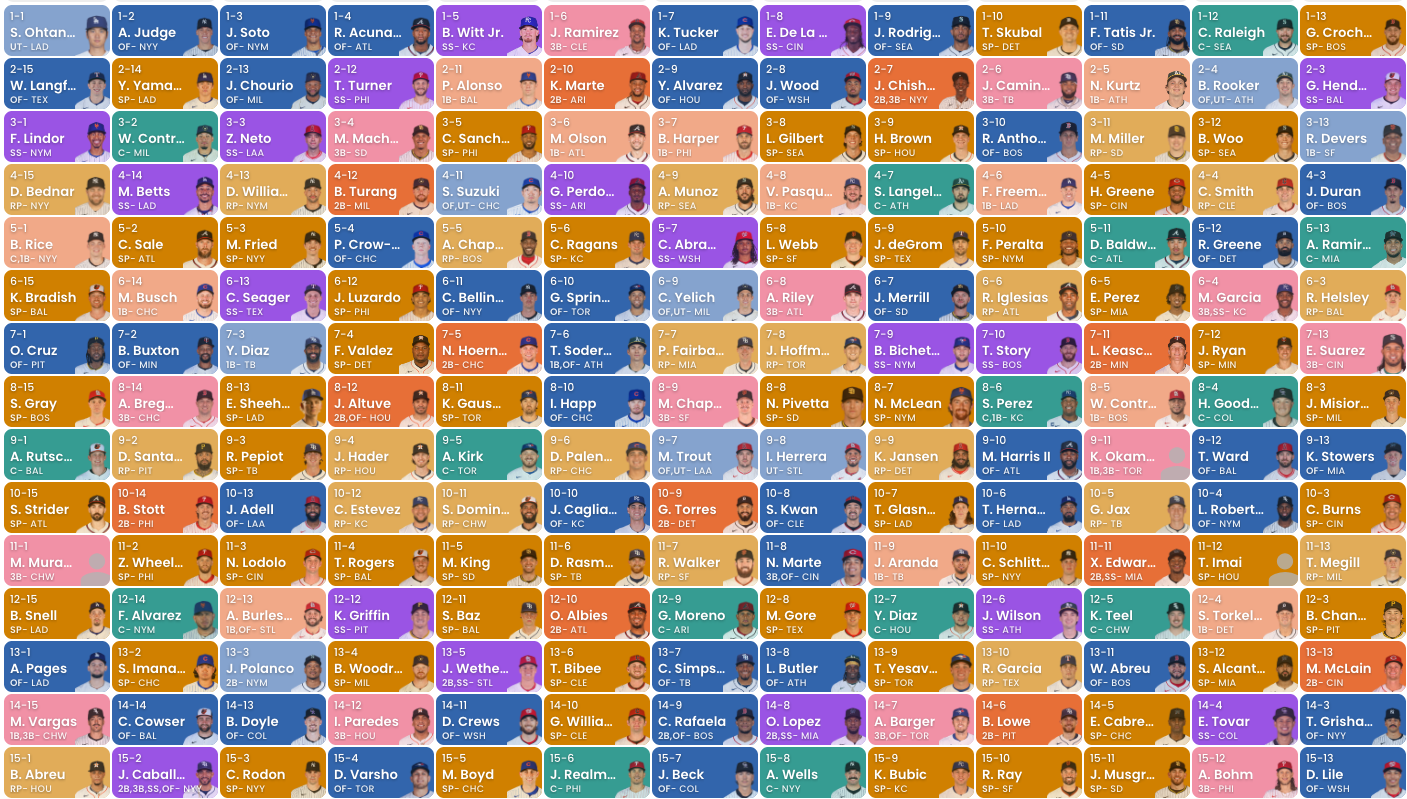
Five takeaways from the Tout Wars Mixed Draft in early March
FREE
Mar 16 2026 3:02am
FREE
Mar 16 2026 3:02am

Pitchers who didn't quite make the Santana Plan filters
Mar 7 2026 3:08am
Mar 7 2026 3:08am

Planning and execution of your draft strategy is key. Here's one example of how it's done, fresh out of Arizona.
Mar 7 2026 3:06am
Mar 7 2026 3:06am

Mar 6 2026 3:06am